
FREE POINT CALCULATIONS
Free Point Calculator
• Modulus of elasticity: 30,000,000 psi (API Spec 5DP)
• Formula: \( L = \frac{\Delta L \times E \times A_s}{F \times 12} \)
• Note: Assumes uniform pipe section; friction neglected.
Free Point in Stuck Pipe Events: A Practical Guide for Oilfield
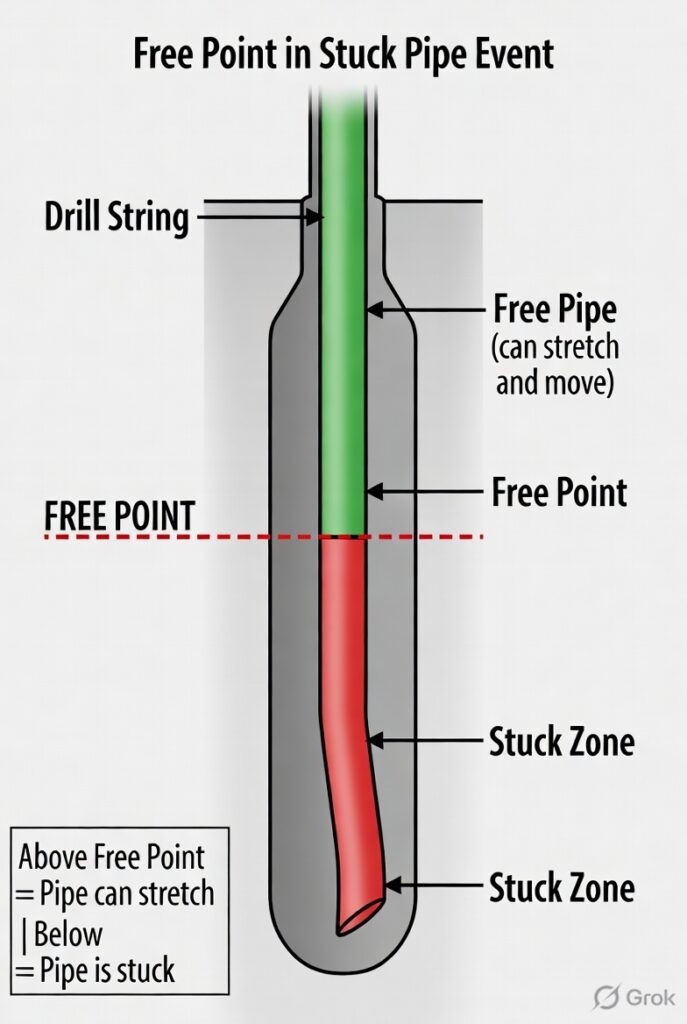
If you’ve spent any time on a drilling rig, you know stuck pipe is one of those things that can ruin your whole shift — and your budget. When the string won’t move or rotate, one of the first smart moves is figuring out the free point. That’s the depth where the pipe above is still movable and everything below is jammed tight.
Let me break it down like we’re sitting in the doghouse talking about it.
What Exactly is the Free Point?
Imagine your drill string is jammed somewhere down the hole. The free point is the exact depth where the pipe above is still “free” (it can stretch or twist) and below which it’s completely stuck.
Knowing this spot is a game-changer. It tells you where to focus your efforts — whether that’s spotting a freeing pill, backing off the pipe, or planning a fishing job. Get it wrong, and you could waste days (or worse) pulling on the wrong section.
Stuck pipe can happen for lots of reasons: differential sticking, key seats, pack-offs, hole collapse, you name it. Once initial freeing attempts (working the string, jarring, etc.) don’t work, it’s time to zero in on that free point.
Why Bother Determining the Free Point?
- It prevents you from over-pulling and damaging good pipe higher up.
- Helps you place chemicals or tools exactly where they’re needed.
- Gives the team a clear picture of what you’re dealing with so you can make smart decisions fast.
- Saves time and money — stuck pipe is expensive enough already!
Method 1: The Old-School Stretch Method (Surface Calculation)
This is your quick-and-dirty way to get a rough idea without calling in tools. It works best in fairly vertical wells.
How it goes:
- Work the pipe a bit first — pull 10-15% over normal weight and slack off to reduce friction.
- Mark the pipe at normal hook load (call this point “a”).
- Apply some safe extra pull (stay well within the pipe’s limits!).
- Slack off again and mark the new spot (“b”).
- Measure the stretch in inches between those marks.
Then plug it into the formula:
Free Point Constant (FPC) = Pipe cross-sectional area × 2500 (You calculate area from OD and ID: (OD² – ID²) × 0.7854)
Free length (ft) ≈ (Stretch in inches × FPC) ÷ Pull force in 1,000 lbs
It’s not perfect — friction, doglegs, and heavy pipe can throw it off — but it gives you a solid starting point.
Method 2: Free Point Indicator Tool (The Accurate Way)
This is where the pros shine. A wireline tool (like the Halliburton Free Point Tool) gets run down the hole.
How it works:
- The tool anchors to the pipe at different depths.
- The surface crew applies pull and/or torque.
- Sensors measure how much the pipe stretches or twists.
- By comparing logs before and after applying force, you see exactly where the pipe stops moving freely.
Modern tools are fast, reliable, and can cut diagnosis time in half. They work great even in deviated wells.
Pro Tips from the Field
- Safety first: Never exceed safe tensile limits on the pipe. Know your numbers!
- In deviated holes, trust the tool more than the stretch math.
- Act fast on differential sticking — time is not your friend.
- Combine this with good torque & drag modeling and caliper logs for the full picture.
- Document everything: pulls, stretches, tool readings. It all helps later.
After you nail down the free point, the real recovery work begins — backing off, spotting pills, fishing, or (if needed) sidetracking.
Finding the free point isn’t flashy work, but it’s one of the most important things you can do when the pipe goes stuck. It turns panic into a proper plan. Whether you’re a driller, assistant driller, or company man, understanding this stuff makes life on the rig a lot smoother.
just a heads-up: This is general info based on common field practices. Always follow your company’s procedures and bring in the experts when it counts.