
DRILL PIPE CAPACITY AND VOLUME CALCULATIONS
DRILL STRING VOLUME CALCULATOR
Drill Pipe Capacity in Drilling Operations
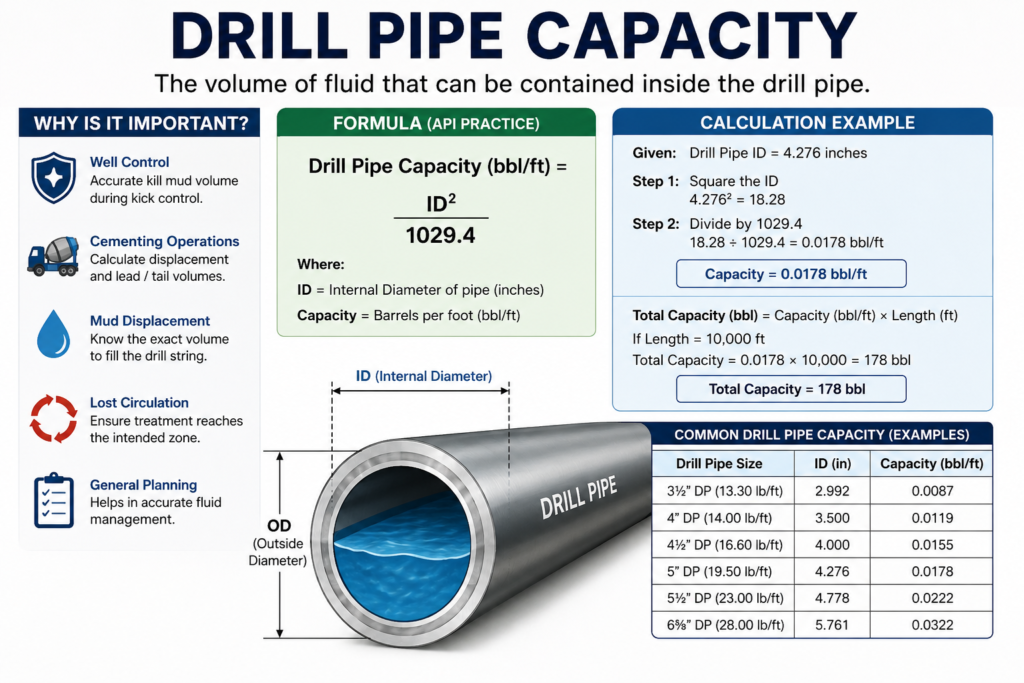
One of the most important calculations performed on a drilling rig is drill pipe capacity. Whether you are planning a cement job, displacement operation, well control procedure, or simply calculating the volume of fluid inside the drill string, understanding pipe capacity is essential.
As drilling personnel, we work with fluids every day. Knowing exactly how much fluid the drill pipe can hold helps us make accurate operational decisions, maintain well control, and avoid costly mistakes. A small error in volume calculations can result in improper fluid placement, increased non-productive time (NPT), and even safety risks.
This is why every driller, assistant driller, derrickman, mud engineer, and well control specialist should understand drill pipe capacity calculations.
What is Drill Pipe Capacity?
Drill pipe capacity is the amount of fluid that can be contained inside a drill pipe or tubular. It is normally expressed in:
Barrels per foot (bbl/ft)
Gallons per foot (gal/ft)
Total barrels (bbl)
The capacity depends primarily on the pipe’s inside diameter (ID). A larger inside diameter means the pipe can hold more fluid.
Why is Drill Pipe Capacity Important?
Accurate drill pipe capacity calculations are critical for several drilling operations:
Well Control Operations
During a kick or well control event, kill mud must be pumped accurately through the drill string. Incorrect volume calculations can affect pressure control and kill procedures.
Cementing Operations
Engineers must know the exact internal volume of the drill string to calculate displacement volumes and ensure proper cement placement.
Mud Displacement
When changing mud systems or displacing fluids, drill pipe capacity determines how much fluid is required to fill the string.
Lost Circulation Treatments
Accurate volumes help ensure lost circulation materials reach the intended zone.
General Fluid Management
Understanding internal pipe volume improves planning and prevents unnecessary fluid waste.
API Standard Formula for Drill Pipe Capacity
The standard oilfield formula used throughout the industry is:
Drill Pipe Capacity (bbl/ft) = ID² ÷ 1029.4
Where:
ID = Internal Diameter of the pipe (inches)
Capacity = Barrels per foot
This formula is derived from the geometric volume of a cylinder and is widely used in accordance with industry practices based on API tubular dimensions.
Example Calculation
Assume a drill pipe has:
Internal Diameter (ID) = 4.276 inches
Step 1: Square the ID
4.276 × 4.276 = 18.28
Step 2: Divide by 1029.4
18.28 ÷ 1029.4 = 0.0178 bbl/ft
Result
Drill Pipe Capacity = 0.0178 bbl/ft
This means each foot of drill pipe holds approximately 0.0178 barrels of fluid.
Calculating Total Drill String Capacity
To determine total capacity:
Total Capacity (bbl) = Capacity (bbl/ft) × Length (ft)
Example
If:
Capacity = 0.0178 bbl/ft
Length = 10,000 ft
Then:
Total Capacity = 0.0178 × 10,000
Total Capacity = 178 barrels
Therefore, the drill string can hold approximately 178 barrels of fluid.
API Tubular Data
API specifications provide standardized dimensions for drill pipe, casing, and tubing. Before calculating capacity, always verify:
Pipe outside diameter (OD)
Pipe inside diameter (ID)
Pipe grade
Pipe weight
Manufacturing tolerances can slightly affect actual capacities. For critical operations, always use the latest tubular data sheets and company-approved references.
Common Mistakes
Using Outside Diameter Instead of Inside Diameter
Capacity calculations always use the internal diameter (ID), not the outside diameter (OD).
Incorrect Unit Conversion
Ensure all measurements are in inches before applying the formula.
Ignoring Tool Joint Effects
Tool joints reduce internal volume slightly. For routine calculations this effect is usually negligible, but it may be considered during detailed engineering calculations.
Wrong Pipe Specifications
Always confirm actual pipe dimensions from pipe tallies or manufacturer data.
Best Practices
Verify pipe dimensions before calculations.
Use approved drilling calculators whenever available.
Double-check volumes during well control and cementing operations.
Record calculations in drilling reports and well programs.
Follow company procedures and API-recommended practices.
Key Takeaways
Drill pipe capacity is the internal volume of the drill string.
Accurate capacity calculations are essential for well control, cementing, and fluid displacement operations.
The standard oilfield formula is:
Capacity (bbl/ft) = ID² ÷ 1029.4
Total volume is obtained by multiplying capacity per foot by total pipe length.
Always verify dimensions using API tubular specifications and company-approved data.
Understanding drill pipe capacity is a fundamental skill for every drilling professional. Accurate calculations improve operational efficiency, reduce risk, and contribute to safer drilling operations.