
ANNULAR CAPACITY AND VOLUME CALCULATIONS
ANNULAR CAPACITY & VOLUME CALCULATOR
Annular Volume in Drilling Operations
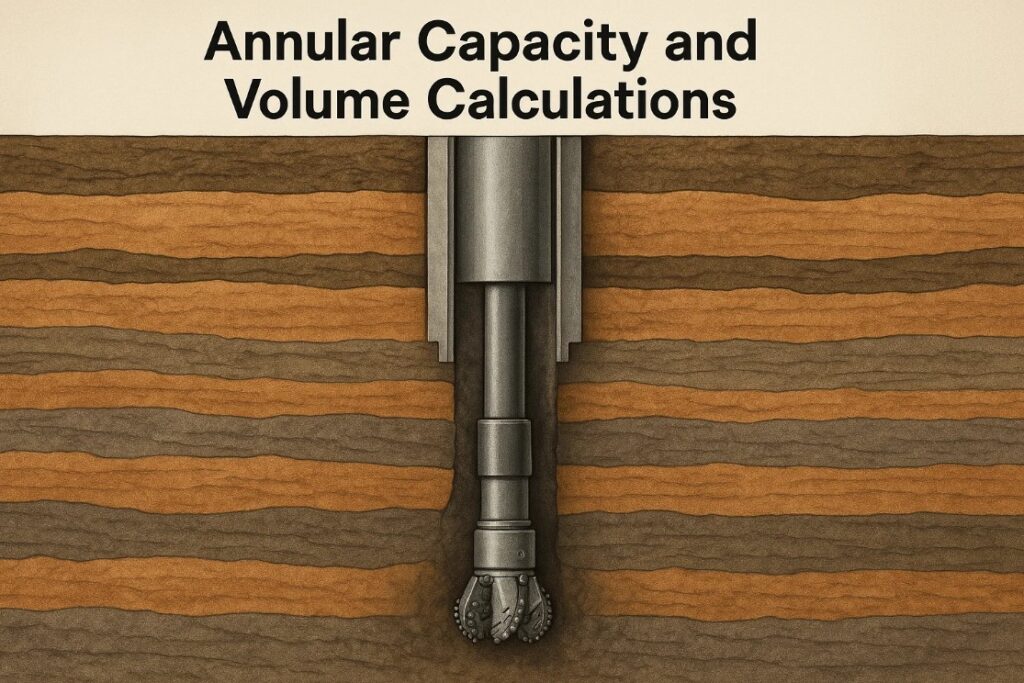
Annular capacity and volume refers to the space between the drill pipe and the wellbore or casing in a drilling operation. It is a important parameter in well control, cementing, and mud circulation, ensuring efficient drilling and wellbore stability. and poor cementing jobs, which can lead to costly operational failures.
How to Calculate Annular Volume
The annular volume formula:
Annular Volume=(Hole Diameter²−Pipe Diameter²) / 1029.4×Well Depth
Where:
- Hole Diameter (DH) = Wellbore or casing inner diameter (inches)
- Pipe Diameter (DP) = Outer diameter of the drill pipe or casing (inches)
- Well Depth = Total vertical or measured depth of the well (feet)
- 1029.4 = Conversion factor to barrels
This formula helps determine the total volume of fluid required to fill the annular space. It is commonly used in well planning, cementing operations, and fluid displacement calculations.
Importance of Annular capacity Calculation.
- Mud Circulation Efficiency – Ensuring accurate annular volume calculations allows proper displacement of drilling mud, reducing the risk of wellbore instability and fluid losses.
- Cementing Accuracy – Cementing jobs rely on precise volume calculations to achieve a strong bond between the casing and formation, preventing fluid migration.
- Well Control – Monitoring annular volume assists in detecting abnormal pressure changes, helping prevent kicks and blowouts.
- Hole Cleaning – Proper annular velocity ensures efficient removal of drilled cuttings, preventing blockages and improving wellbore quality.
- Cost Optimization – Overestimating or underestimating fluid volumes can lead to increased operational costs and inefficiencies.
Annular volume calculations are fundamental in drilling operations, By accurately determining annular volume, drilling engineers can optimize mud circulation, enhance well control, and ensure successful cementing jobs. Proper planning based on these calculations leads to safer and more cost-effective drilling operations.
intructions to feed input data to Annular Capacity And Volume Calculations
In this annular capacity and volume calculations, the order of sections doesn’t affect the final total volume, but logically and operationally, you should calculate from bottom to top (starting with the open hole section, then casing sections upward)
Recommended Order: Open Hole → Casing (Bottom-Up)
Open Hole Section (Bottom)
Represents the deepest part of the wellbore (no casing).
Typically drilled first, so it should be calculated first in the sequence.
Example: If you have drill pipe inside an open hole, this annular volume is calculated first.
2. Casing Sections (Upward)
Each subsequent casing string is run inside the previous one.
Example: After the open hole, you might have:
Production casing (innermost)
Intermediate casing
Surface casing (outermost)
Why This Order?
Matches Well Construction: Wells are drilled and cased from bottom to top.
Avoids Confusion: Clear progression from deepest to shallowest section.
Input Validation: Helps ensure lengths don’t exceed the section above (e.g., drill pipe in open hole shouldn’t be longer than the open hole itself).
How the Calculator Handles It
In the provided code, sections are calculated in the order they’re added (user-defined).
Key Point: The calculator treats each section independently, so the mathematical result is the same regardless of order (total volume is a sum of all sections).
Recommendation:
Add sections bottom-up (open hole first, then casings upward) for logical consistency.
The dropdown menu defaults to “Casing” first, but you can select “Open Hole” for the deepest section.
Example Workflow
Add Open Hole Section
OD = Wellbore diameter (e.g., 8.5″)
Length = Drilled depth (e.g., 10,000 ft)
Add drill pipe strings inside it (e.g., 5″ DP @ 9,500 ft).
Add Casing Sections
Next: 9⅝” casing (e.g., 8,000 ft)
Then: 13⅜” casing (e.g., 5,000 ft)
Finally: Surface casing (e.g., 20″ @ 2,000 ft).
Calculate
The tool sums volumes from all sections, but the logical flow follows well construction.
Mathematically: Order doesn’t matter (total volume = sum of all annular volumes).
Practically: Input sections bottom-up (open hole → casings) to mirror real-world well design.
The calculator will work correctly either way, but bottom-up entry is more intuitive for well engineers.